30 May Exercise Order in Training: Does Sequence Affect Strength Output?
When you walk into a weightlifting gym, it can be tempting to choose exercises based on what equipment is open or what you want to do first. Perhaps, you might start with curls, move to squats, add some presses, then finish with deadlifts if you still have energy. While that kind of workout is better than doing nothing, the order of your exercises can actually affect how much strength you produce, how well you move, and how much quality work you complete.
- Why Exercise Order Matters in Strength Training
- Starting With Heavy Compound Movements
- Where Isolation Exercises Fit Best
- How Exercise Order Changes Based on Goals
- Building Smarter Workouts With Flex Fitness
Exercise order matters because your body does not perform every lift under the same conditions. The first few exercises in your workout usually get your best effort. Fresh, focused, and able to control your technique better. As the workout continues, fatigue builds, and our muscles, joints, grip, breathing, and focus might all start to decline. That’s why a lift that feels strong at the beginning of a session can feel much harder later, even if the weight on the bar is the same.
Let’s explore how exercise order affects strength output and why the sequence of your lifts can shape the quality of your entire workout.
Why Exercise Order Matters in Strength Training
Exercise order is an important resistance training variable because it can affect both short-term workout performance and long-term training adaptations. The exercises you perform earlier in a workout usually receive the most energy, focus, and strength output. When you are fresh, you can lift more weight, complete more reps, and maintain better technique. Research has shown that exercises placed at the beginning of a session lead to greater strength gains than exercises that follow.
Fatigue from one movement can reduce your performance in later lifts. For example, if you do several hard sets of leg extensions and lunges before squats, your legs might already be tired before you reach the most demanding exercise. That fatigue can lower your strength output, reduce your training volume, and make it harder to maintain good technique. Over time, a random workout order can limit progress because the exercises you care about most might not consistently receive your best effort.
Starting With Heavy Compound Movements
Squats, deadlifts, presses, and rows involve several joints and muscle groups working together. These lifts demand strong bracing, stable positioning, and good control from the first rep to the last. If you do them after several tiring accessory exercises, you might still be able to finish the workout, but your strength output and form might not be as strong. That’s why many strength training programs begin with large, multi-joint exercises before moving into smaller assistance or isolation work.
Furthermore, starting with heavy compound lifts helps preserve power and reduce the chance of sloppy movement. Technical exercises become riskier when you perform them while tired because fatigue can affect your posture, bar path, balance, and ability to stay tight through the lift. For example, a tired deadlift might turn into a rounded-back pull. A well-planned exercise order enables you to train harder where it counts without letting fatigue compromise the quality of your session.
Where Isolation Exercises Fit Best
Isolation exercises usually fit best after your main strength movements. Such movements focus on one main joint or a smaller muscle group, such as biceps curls, triceps pushdowns, lateral raises, leg extensions, hamstring curls, or calf raises. These let you add focused work without the same level of total-body demand required for squats, deadlifts, presses, and rows. For most lifters, it makes sense to complete the heavy, technical work first, then use isolation exercises to build weak areas, improve muscle balance, and add extra training volume.
Other lifters use pre-exhaustion, where an isolation exercise is performed before a compound lift to make a target muscle work harder. It can be useful in some hypertrophy-focused plans, but must be programmed carefully. Note that while pre-exhaustion can produce fatigue and performance responses similar to traditional exercise order, it might not offer greater benefit. When training in a weightlifting gym, the safer and more practical approach is to place isolation exercises after the main lifts unless there is a clear reason to do otherwise.
How Exercise Order Changes Based on Goals
The ideal exercise order depends on specific training goals. If your main goal is maximum strength, start your workout with the heaviest and most technical lifts. That might mean squats before leg press, bench press before flyes, deadlifts before hamstring curls, or overhead press before lateral raises. Strength training depends on high force output, good technique, and enough rest between hard sets. If you place heavy lifts too late in the workout, fatigue can lower your numbers and make your progress harder to measure.
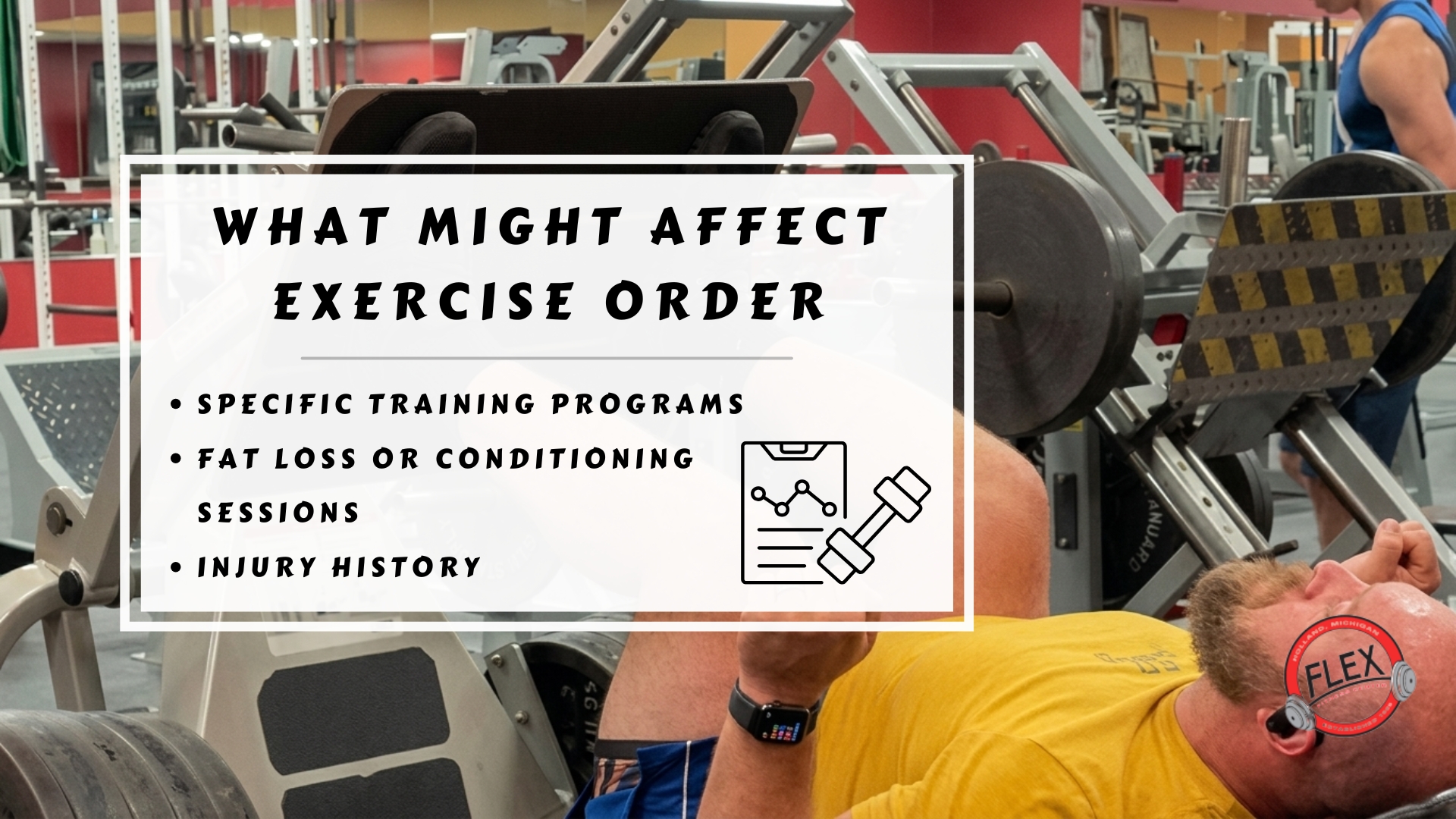
Hypertrophy, fat loss, conditioning, injury history, and weak points can all change the best sequence. For muscle growth, you can organize your workout around the muscles you want to develop most, even if that means starting with a smaller muscle group. If your goal is fat loss or conditioning, you can use circuits, supersets, or alternating upper- and lower-body exercises to keep your heart rate higher. If you are training around an injury or joint pain, you can start with warm-up drills, mobility work, or lighter activation exercises before heavier lifts.
Building Smarter Workouts With Flex Fitness
The right exercise order can help you get more out of every training session. When you place your most important lifts early, manage fatigue, and use accessory work with a clear purpose, your workouts become more focused and productive. Instead of moving from one machine to another without a plan, you can train in a way that supports strength, muscle growth, better technique, and long-term progress.
Flex Fitness Center is here to give you the space, equipment, and support you need to train smarter. Our weightlifting gym is designed to help you make the most of your workouts. We have certified personal trainers who can structure your sessions around your goals and build a routine that makes sense for your body. Visit us today to explore our facility. For inquiries, you can reach out to us at (616) 396-2901 or here.