30 Mar Eccentric Training for Strength: Why the Lowering Phase Builds More Resilience
When you want to get stronger, it is easy to focus on the part of a lift where you push, pull, or stand up with the weight. But the lowering phase matters just as much, and in many cases, it might do even more for long-term progress. That part of the movement challenges your muscles in a different way, keeping them engaged while resisting gravity and controlling the load. That’s one reason eccentric training has become an important part of smart strength training programs. Whether you train at home or in a weightlifting gym, learning to control the lowering phase can make your workouts more effective.
- What Eccentric Training Actually Is
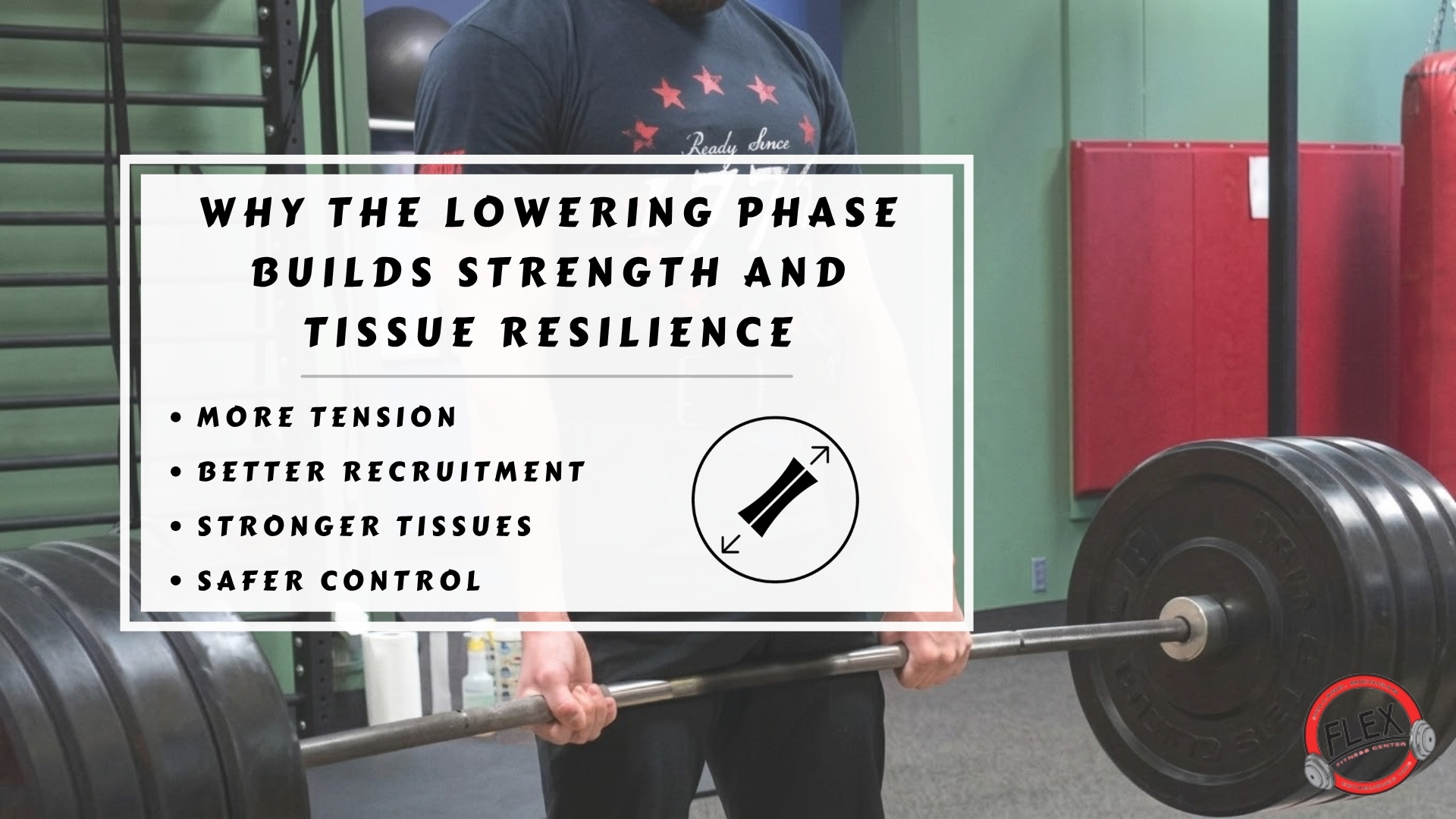
- Why the Lowering Phase Builds Strength and Tissue Resilience
- How to Program Eccentric Training Correctly
- Applying Eccentric Training Safely in a Structured Program
Let’s explore how eccentric training can help you build more strength, lift with better control, protect your joints, and become more resilient under load.
What Eccentric Training Actually Is
Eccentric training focuses on the lowering phase of a lift, the part of the movement where the muscle is working while it lengthens. For example, when you lower into a squat, bring a barbell down to your chest in a bench press, or lower a dumbbell during a bicep curl, your muscles are not relaxing, but staying active to control the descent. That controlled lowering phase places your body under load in a very specific way, different from simply just “lowering the weight.”
Eccentric contractions differ from the other phases of movement. In a concentric phase, your muscle shortens as it produces force, such as when you press the weight up. In an isometric phase, the muscle produces force without changing length. Meanwhile, in an eccentric phase, the muscle lengthens while still under tension. That combination of tension and control is what makes eccentric training so valuable for building strength and better movement mechanics.
Why the Lowering Phase Builds Strength and Tissue Resilience
The lowering phase places your muscles and connective tissues under a type of stress that can help them adapt in useful ways. When done with good form and proper loading, that part of a lift can improve strength, body control, and your ability to handle force safely. That’s why eccentric work deserves more attention in your training plan.
More Tension
During the eccentric phase, your muscles can handle high levels of force while lengthening, creating strong mechanical tension. Because the muscle is resisting the load over a longer range, it experiences a deep training stimulus that can support both size and strength gains without needing extra volume. The added tension can make eccentric-focused reps especially valuable when you want to challenge your body in a controlled way. Instead of rushing through the lowering phase, slowing it down increases the amount of work your muscles have to do.
Better Recruitment
Controlled eccentric work demands focus, coordination, and precise force production, and your body has to organize the movement carefully so the weight stays on the right path and your joints stay in good position. That process helps improve motor unit recruitment, meaning more muscle fibers are called into action in a controlled way. Moreover, when you practice controlled lowering, you improve the connection between your brain and your muscles, leading to better technique, cleaner reps, and stronger performance when it is time to lift explosively.
Stronger Tissues
Muscles are only part of the picture. The lowering phase places useful stress on tendons and other connective tissues. When that stress is introduced gradually and consistently, those tissues can adapt by becoming better able to handle load. Tissue resilience matters because your muscles do not work alone. Tendons help transfer force, while connective tissues support joint function and movement efficiency. When you train your body to handle load while lengthening, you help the whole system become more prepared for repeated effort.
Safer Control
During workouts and even in real life, many injuries happen not because of force production, but due to poor force absorption. Think about landing from a jump, changing direction quickly, or lowering a heavy object. In each case, your body needs to know how to slow down, stabilize, and control motion safely. Eccentric training develops that skill by teaching your muscles and joints to handle load during the braking phase of movement. It gives you more confidence under load and helps your body respond with better control when movement gets challenging.
How to Program Eccentric Training Correctly
To program eccentric training correctly, start by slowing the lowering phase of your main lifts to about three seconds per rep. That gives your muscles more time under tension and teaches you to control the weight instead of letting gravity take over. Tempo prescriptions are a simple way to do that in a structured strength program. For example, you can use a squat or bench press tempo that emphasizes a slow descent before driving the weight back up with good form. That approach works well in both beginner and advanced programs because it helps you focus on quality movement while still building strength.
In addition, you can incorporate progressive overload, but you need to apply it carefully. Since your body can usually handle more weight eccentrically than concentrically, advanced methods can increase the challenge. Still, more is not always better. Eccentric-focused work creates more muscle damage and soreness, so recovery has to be part of the plan. That means keeping volume reasonable, paying attention to how your body responds, and having quality sleep. When used with the right balance, eccentric work can make your training more effective without leaving you too fatigued to progress.
Applying Eccentric Training Safely in a Structured Program
The best results from eccentric training come when it is built into a structured plan instead of added randomly. Tempo work fits especially well into compound lifts because these movements train multiple muscle groups at once and help you practice control under meaningful loads. When you slow the lowering phase of squat, bench press, or Romanian deadlift, for instance, you build better technique and stronger movement patterns that carry over to the rest of your training. Over time, that can help you get more out of every session while reducing the chance of careless reps and unnecessary strain.
At Flex Fitness Center, you can train in an environment that supports smart progression, proper form, and long-term results. Our certified personal trainers can help you use eccentric methods in a way that matches your current ability and goals, so you can build strength that lasts without taking on unnecessary injury risk. We offer supplements from reputable brands to support your workout, recovery, and overall performance. If you want to train smarter, visit us today or contact us at (616) 396-2901 or here for inquiries. Let us help you train with purpose and get more out of every rep.